
NASA Acres Develops County-Level Yield Forecasting Models
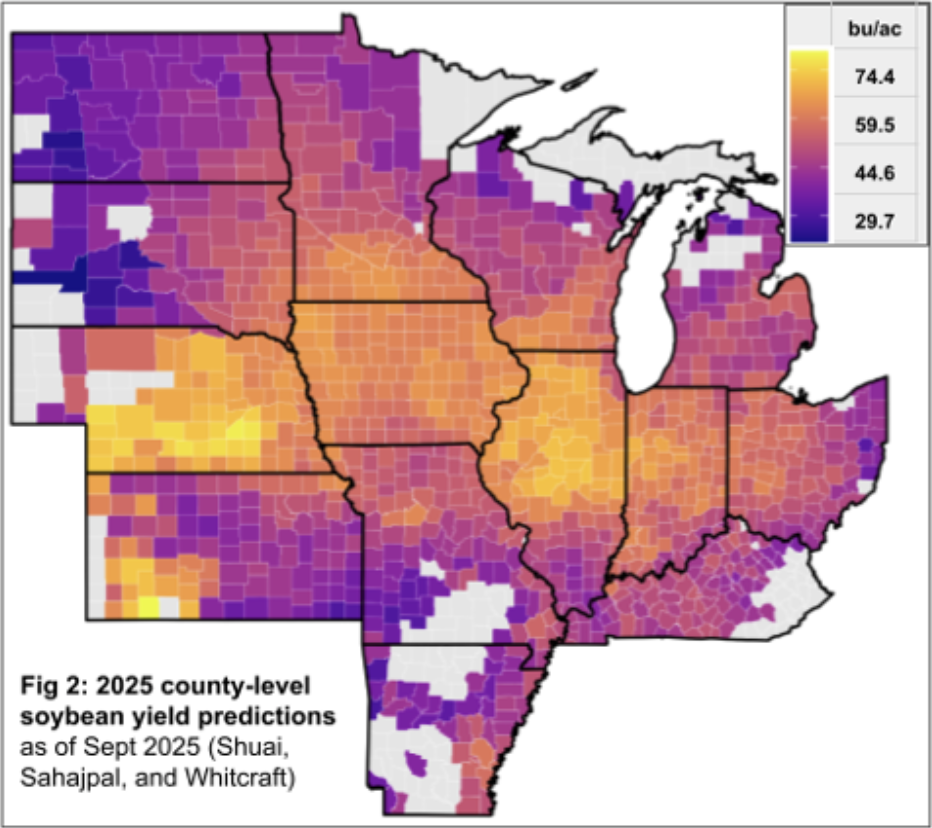
NASA Acres is helping bring county-level crop yield forecasting closer to practical use.
Led by NASA Acres Research, Development and Extension (RD&E) partners Drs. Ritvik Sahajpal and Guanyuan Shuai of the University of Maryland with inputs from NASA Acres director Dr. Alyssa Whitcraft, this work uses NASA’s Earth observation data and weather information to forecast corn and soybean yields across a dozen Midwestern states.
The model combines several Earth observation and weather datasets, including Green Chlorophyll Vegetation Index (GCVI) from MODIS, NASA SERVIR’s Evaporative Stress Index (ESI), and AgERA5 precipitation data. To estimate yields, the team uses a Generalized Additive Model, a flexible statistical approach that can better capture how crops respond to changing field and weather conditions over the season.
Designed to complement other estimates, this work explores how satellite data can provide timely, high-quality science-based information at levels finer and earlier than USDA NASS estimates. Results to date have been encouraging, with county forecasts comparing well to broader state and regional estimates as early as three-four months before harvest. The forecasts have also generally aligned with later published USDA crop condition reports and other Earth observation tools, showing that the approach can capture seasonal patterns seen across many growing areas.
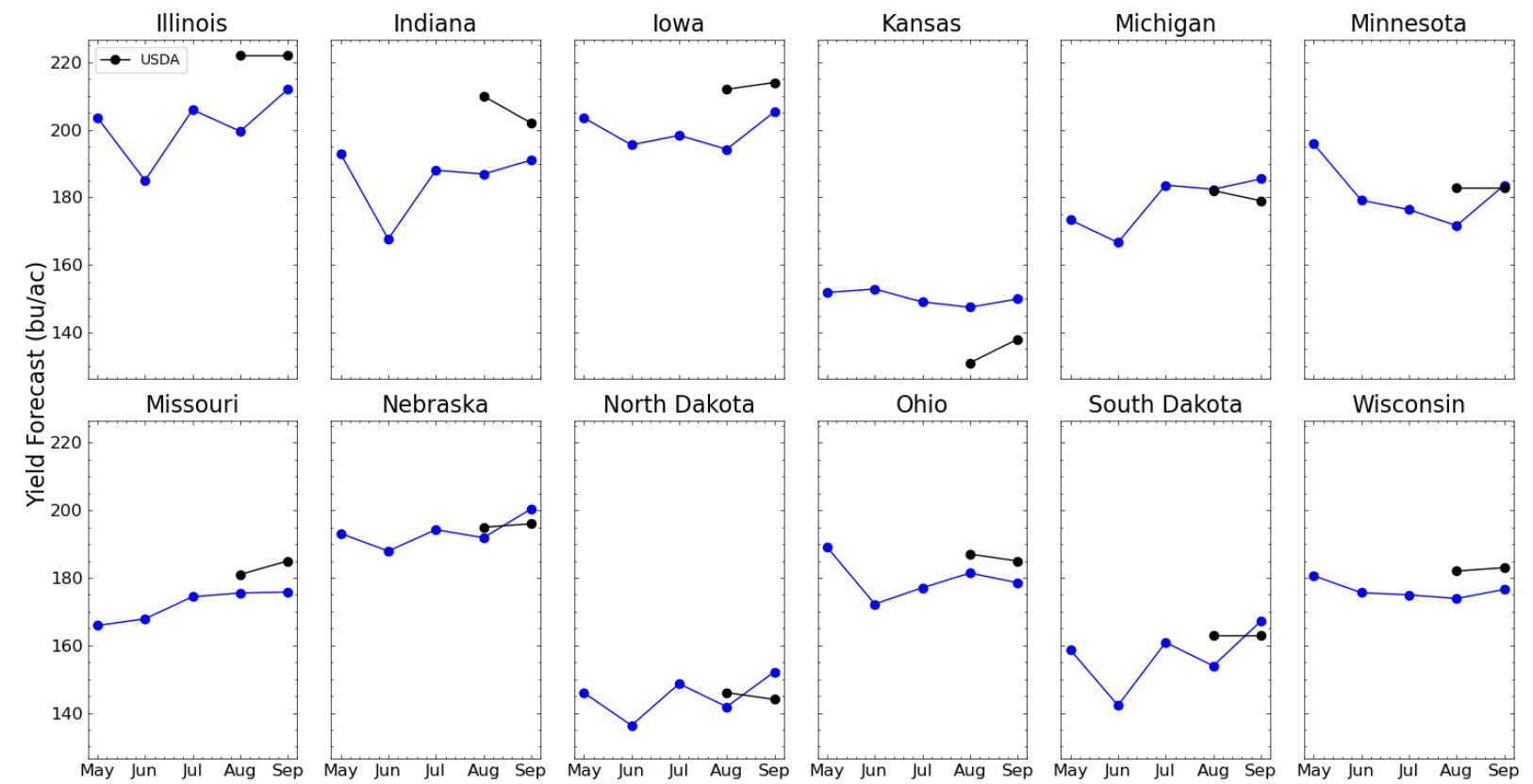
In 2024 for a 12-state region in the Midwest, we forecast corn yield of 188.82 bu/ac (blue line) vs USDA: 183.8 bu/ac (black line)
A major focus of the project is making these forecasts usable in real-world settings. Rather than remaining confined to research papers, the yield models are being translated into practical applications for the people and organizations that can benefit from them, such as commodity and farming associations. NASA Acres is helping close this gap by expanding access to the models, sharing results with partners, and developing platforms and tools that make the forecasts easier to access and interpret, all in line with our data governance principles that respect the primacy of the farmer’s right to information.
Looking ahead, the team plans to update forecasts regularly, expand to more crops such as wheat, rice, sorghum, and cotton, and continue improving the model with additional data and new methods. As highlighted in a recent NASA Harvest analysis comparing crop yield modeling approaches, different forecasting methods offer unique strengths depending on the agricultural context and decision-making needs. The broader goal is to create a yield forecasting system that is both scientifically strong and practically useful across American agriculture.