Garden City Community College Completes Pilot Course with NASA Acres
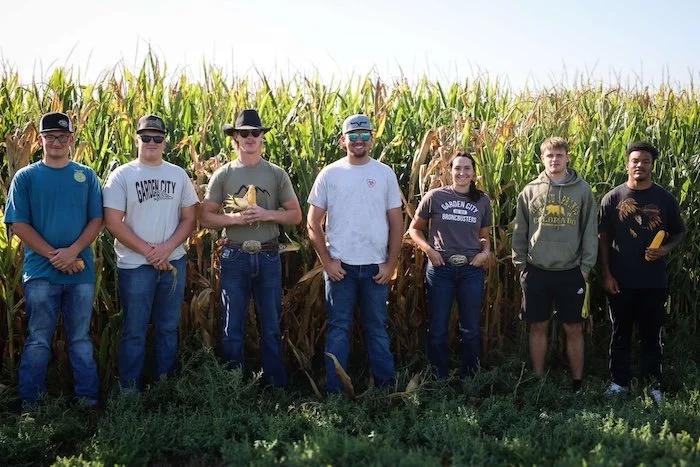
Garden City Community College (GCCC) students gather data in an irrigated Kansas corn field. Photo courtesy of GCCC.
Garden City Community College (GCCC) in Garden City, Kansas has successfully concluded the first offering of Technology in Agriculture (AGRO-111), a course developed in collaboration with NASA Acres and Kansas State University and launched in Fall 2025. This partnership aligns closely with NASA Acres goals to support agricultural workforce development and expand access to Earth observation tools for students and educators.
Led by Assistant Professor Elisa Mai, the course gave students practical experience with the use of satellite data in real agricultural settings. "It was rewarding to see students from a wide range of backgrounds engage with NASA Acres tools and discover that modern agriculture goes far beyond putting seeds in the ground,” said Professor Mai.
“I’m excited to continue sharing these decision-making tools and helping students see how data and technology will continue to reshape today’s crop production industry. Every acre of crop counts more than ever, making informed decisions critical to farming success."
Students learned how to interpret NASA observations to monitor crop health, analyze geospatial information using QGIS — an open-source software that lets users turn data into interactive maps and insights — and connect classroom exercises to field visits across Southwest Kansas. Integral to fostering this partnership was NASA Acres Farm Innovation Ambassador Team (FIAT) Steering Committee member Dwane Roth.
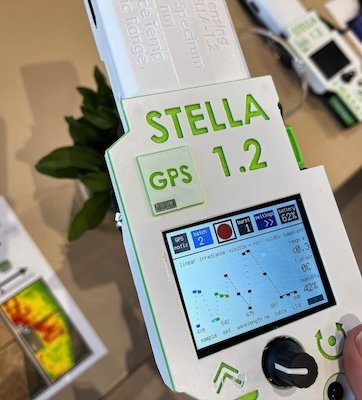
Students examine STELLA instruments at the GCCC STEM Fair. Photo courtesy of GCCC.
As part of the curriculum, students used STELLA instruments to collect field measurements and compare them with satellite imagery. STELLA, which stands for Science and Technology Education for Land/Life Assessment, is a low-cost, open-source handheld spectrometer that measures how plants and other surfaces reflect visible and near-infrared light. It gives students a hands-on way to understand the same principles behind satellite-based vegetation monitoring. Instructor Elisa Mai also showcased the STELLA instruments at the GCCC STEM Fair, which helped increase campus-wide awareness of how remote sensing supports agricultural decision-making.
Students responded positively to the mix of hands-on fieldwork and step-by-step classroom instruction. They highlighted the value of QGIS, instructional guides provided through the course, as well as opportunities to hear from guest speakers who work with agricultural and geospatial technologies. Students also reported that the skills gained in the course strengthened their resumes and helped them pursue internships.
The course brought positive attention to GCCC and NASA Acres through local radio interviews, newspaper coverage, social media engagement, and campus events that showcased the college as a growing hub for agricultural innovation.
The pilot demonstrated that accessible geospatial tools combined with practical agronomy training can significantly enhance student learning. NASA Acres will continue working with education partners like GCCC to support programs that prepare the next generation of agricultural professionals.
Learn more about how NASA Acres connects technology and agriculture:
https://www.nasa.gov/nasa-acres/technology-and-agriculture/
Read the original GCCC announcement:
https://www.gcccks.edu/events/gccc_to_launch_new_agriculture_technology_course_this_fall_in_collaboration_with_nasa_acres.aspx